


No MRF Pipelines. Query Trillions of Contracted Rates in Seconds
One API key. Three endpoints. Search provider rates, pull fee schedules, or compute market percentiles.
Built for production workloads
We index every contracted rate from every published MRF — and make it all queryable through a fast, provider-exclusive REST API.
of Negotiated Rates
Median Response Time
Commercial Payers
API Uptime SLA
Real negotiated rates. No data pipeline to maintain.
Filter by payer, billing code, provider, geography, plan, or network – and get answers in seconds.
Map provider-payer relationships
Build provider directories or power care navigation with real network data. Pass an NPI or Tax ID, get back every associated TIN, payer, and taxonomy.
Look up negotiated rates
Get the exact dollar amount a payer has contracted with a provider. Filter by billing code, modifier, and place of service.
Benchmark against the market
Pull 25th–99th percentile rates for any billing code by payer, state, and taxonomy. See where any rate falls relative to market.
What teams build with the API
Whether you're building a product, running analytics, or automating revenue cycle workflows — the API fits right in.
Underpayment Detection
Flag underpayments automatically and recover lost revenue.
Fee Schedule Management
Build fee schedules with real market rates, not surveys.
Rate Benchmarking
See where your rates fall against market percentiles.
Provider Directories
Build accurate directories from NPI, taxonomy, and network data.
Market Expansion
Model reimbursement rates in new geographies before you expand.
Cost Estimators
Power patient-facing cost estimators with real negotiated rates.
What is a price transparency API?
Commercial payers are required to publish machine-readable files (MRFs) with their negotiated provider rates under the CMS Transparency in Coverage rule. Most organizations struggle to wrangle these massive JSON files, often 100GB+ per payer.
PayerPrice processes and indexes MRF data from 200+ commercial payers into a REST API. You get clean, structured negotiated rate data back in under two seconds. No pipeline to build or maintain.
How teams actually use it
The most common pattern we see: a billing or revenue cycle team wants to automate underpayment detection. They compare contracted rates against what actually came back on the remittance and flag the gaps. That used to be a manual, line-by-line audit.
Healthcare platforms embed rate lookups into their own products: cost estimators, network adequacy tools, booking flows. They need the contracted rate as a starting point, and building their own MRF ingestion pipeline isn't a good use of their engineering team.
Consulting firms pull bulk rates across payers and geographies for M&A diligence and contract negotiation support. Enterprise provider networks feed the data into Tableau or Power BI to benchmark fee schedules across facilities and identify underpaid codes.
Contracted rates vs. claims data
Claims data reflects what was paid after adjudication, including denials, adjustments, and patient responsibility. Contracted rates are what payers have agreed to pay.
PayerPrice delivers actual contracted rates from payer MRF filings. Not survey averages, not claims proxies. The data covers CPT, HCPCS, MS-DRG, revenue codes, NDC, and J-Codes across 10,000+ commercial plans and 4M+ providers nationally.
Works with your existing stack
The API returns paginated JSON with built-in benchmarks. Filter by payer, billing code, provider NPI, geography, plan, or network. Most teams are live within a day. If your workflow runs on Snowflake or Databricks, we also offer direct data shares with zero ETL.
Ready for AI-native workflows
PayerPrice offers a Model Context Protocol (MCP) server that lets any compatible AI model or agent query negotiated rates, provider data, and market benchmarks directly. Connect natively in Claude, Cursor, or your own custom AI agents — no custom integration code required.
Your AI workflows get the same structured rate data, the same filters, and the same accuracy as the REST API. Build AI-powered rate analysis, automate contract reviews, or add real-time reimbursement intelligence to your agents.
Interactive API Playground
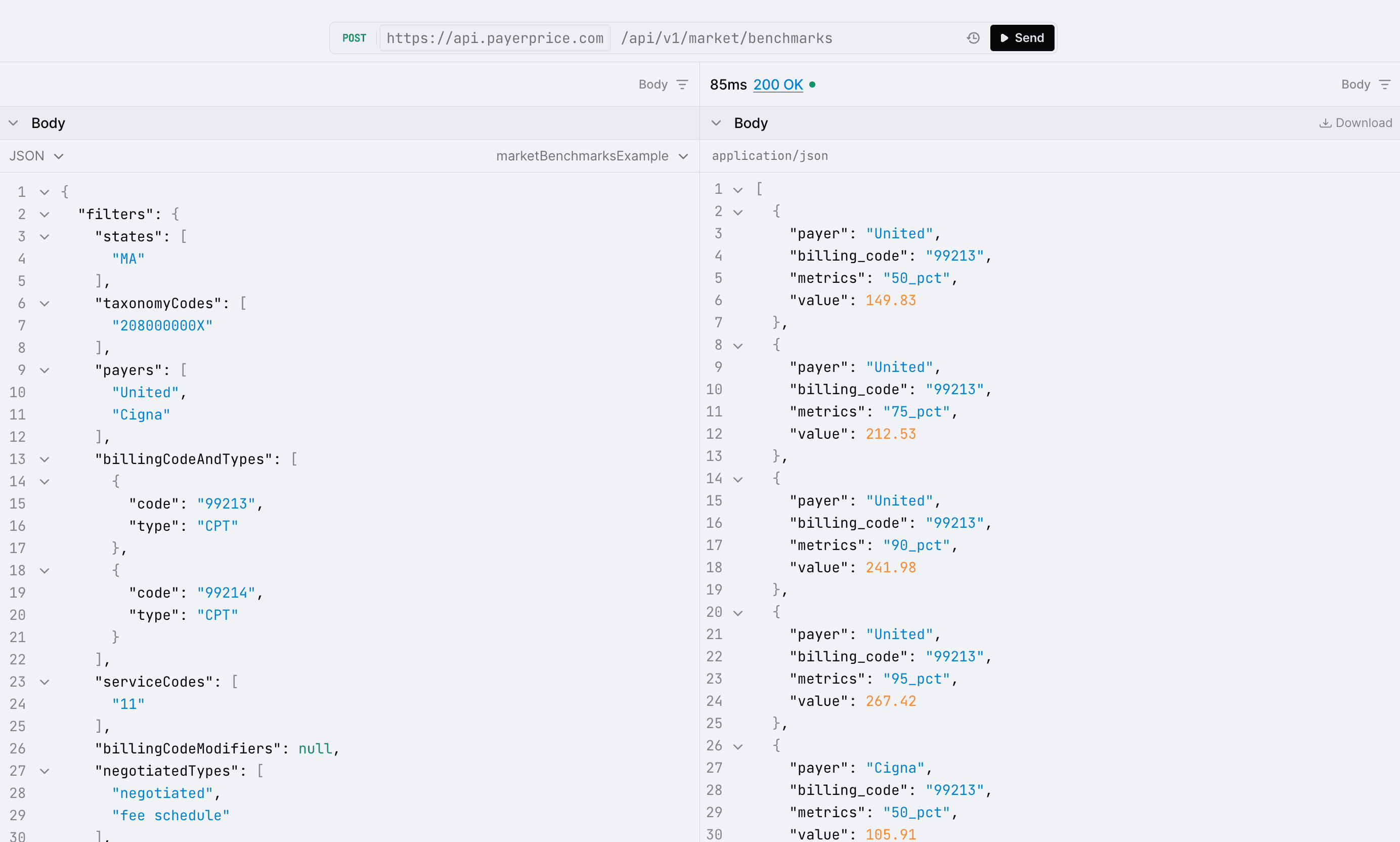
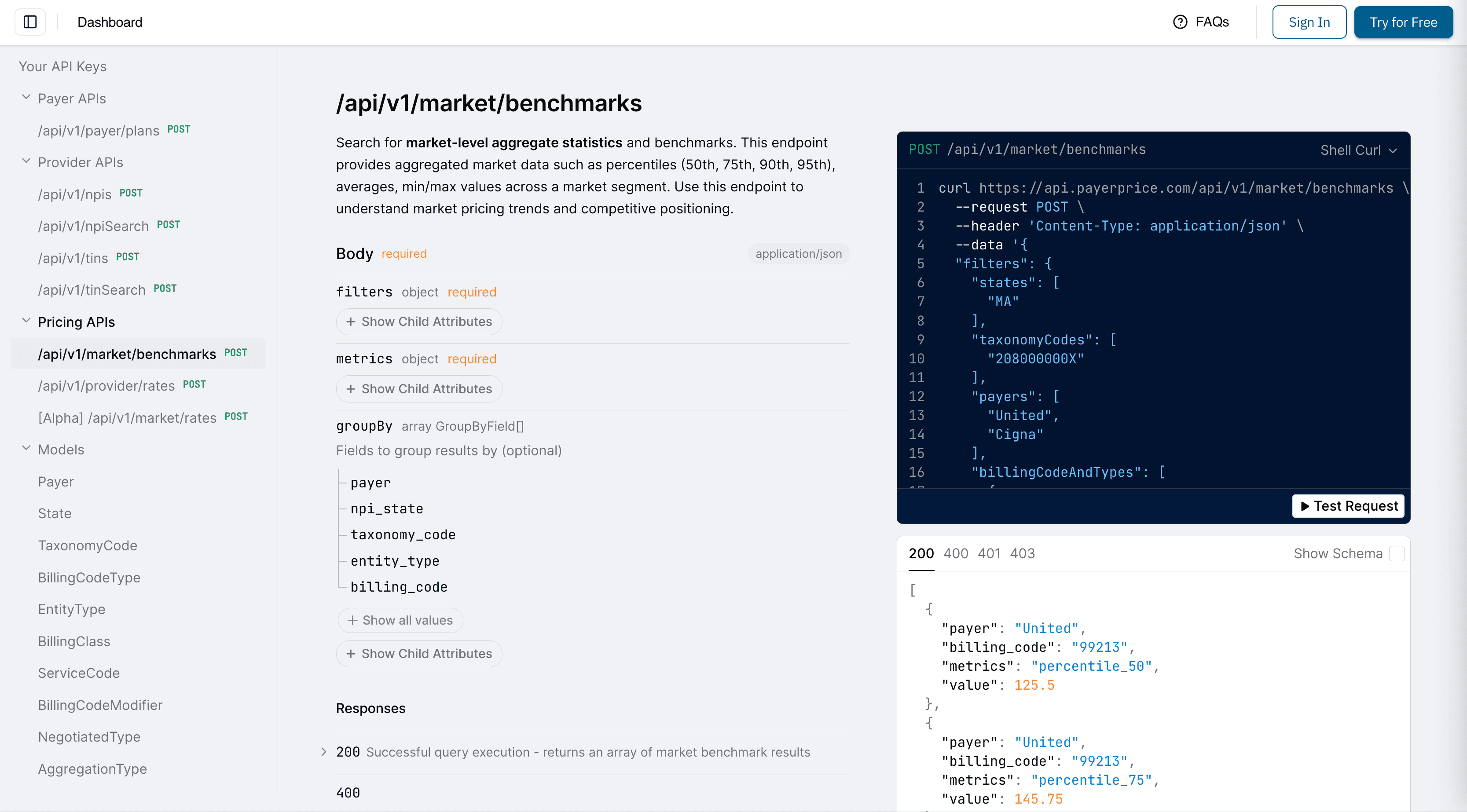
Send real requests and see real responses right in your browser. Explore every endpoint, filter, and response field, then copy working code samples into your integration.
Monthly data refreshes
New MRF data indexed and queryable within days of payer publication, every month.
Built-in Medicare benchmarks
See any rate as a percentage of Medicare for apples-to-apples comparison across payers.
One request, the full picture
Pull rates for multiple providers, codes, and payers in a single request.
See what the API returns
A single API call gets you real negotiated rates. Request access and start sending requests in minutes.
POST /market/benchmarks

{
  "filters": {
    "states": ["MA"],
    "taxonomyCodes": ["208000000X"],
    "payers": ["United"],
    "billingCodeAndTypes": [
      { "code": "99213", "type": "CPT" },
      { "code": "99214", "type": "CPT" }
    ],
    "serviceCodes": ["11"],
    "billingCodeModifiers": null,
    "negotiatedTypes": [
      "negotiated",
      "fee schedule"
    ],
    "billingClasses": ["professional"]
  },
  "metrics": {
    "aggregations": [
      "percentile_50",
      "percentile_75",
      "percentile_90",
      "percentile_95"
    ]
  },
  "groupBy": ["payer", "billing_code"]
}[
{
"payer": "United",
"billing_code": "99214",
"metrics": "50_pct",
"value": 214.75
},
{
"payer": "United",
"billing_code": "99214",
"metrics": "75_pct",
"value": 307.10
},
{
"payer": "United",
"billing_code": "99214",
"metrics": "90_pct",
"value": 349.66
},
{
"payer": "United",
"billing_code": "99214",
"metrics": "95_pct",
"value": 379.45
},
{
"payer": "United",
"billing_code": "99213",
"metrics": "50_pct",
"value": 149.83
},
{
"payer": "United",
"billing_code": "99213",
"metrics": "75_pct",
"value": 212.53
},
{
"payer": "United",
"billing_code": "99213",
"metrics": "90_pct",
"value": 241.98
},
{
"payer": "United",
"billing_code": "99213",
"metrics": "95_pct",
"value": 267.42
}
]“In one instance, we were prepared to accept sub-optimal rates based on flawed rate assumptions, and reversed course once we got access to PayerPrice.”
Real negotiated rates. One API call away.
Tell us about your use case and get a trial API key to start building.
100 free searches. No credit card required.
API FAQs
Your questions answered
Request access and we will review your use case and set you up with a trial API key. Once you have a key, you can send live requests through our interactive docs or integrate directly. Every request authenticates via an API key in the Authorization header.
Default plans include generous rate limits with burst allowances for spiky workloads. If you need higher throughput for production use cases, contact us and we'll adjust your limits.
We process new machine-readable files from payers every month. When new data is available, it's indexed and queryable through the API within days of publication.
Every rate in the API comes from the machine-readable files (MRFs) that commercial payers are required to publish under the CMS Transparency in Coverage rule. We ingest, normalize, and index these payer-published files monthly. No surveys, no estimates, no claims proxies — actual contracted rates straight from payer filings.
The rates come directly from payer-published filings, so accuracy starts at the source. We handle the hard parts — entity matching, payer reporting inconsistencies, contract structure normalization — and we tend to manage that complexity better than most. Payer data has known quality issues industry-wide, so we recommend validating against your own contracts during onboarding. We'll walk you through a live data audit with your own codes.
The API supports CPT, HCPCS, MS-DRG, revenue codes, NDC, and J-Codes. Coverage includes all major BUCA payers plus over 200 regional commercial plans.
Yes. Every endpoint supports filtering by payer, plan name, network, state, taxonomy, billing code, place of service, and modifier. You can combine filters to get exactly the slice of data you need.
All endpoints return paginated JSON with standardized schemas. Every response includes metadata like total count, page info, and request ID for debugging.
Yes. Request access and we will issue a trial API key so you can send real requests through our interactive docs and test your integration. The trial environment mirrors production schemas exactly — no surprises when you go live.
Trial access is free — request a key and start testing. Production plans are priced based on usage and use case. We will walk through pricing options during your onboarding call.
Can't find what you're looking for? Contact our engineering team